Dental Implants · 8 min read
Dental Implant Cost: What You'll Really Pay and Why It Varies So Much
- Written by
- 1PleasantonDentist Editorial Team, Editorial team
- Reviewed by
- Editorial team
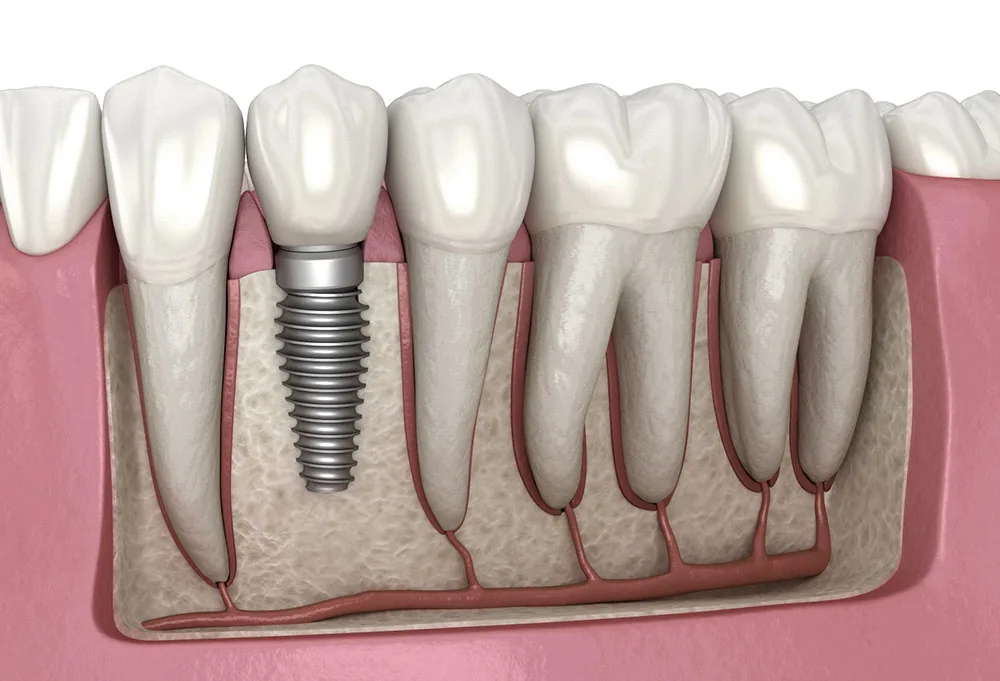
Image: Alexmit art · BY-SA 4.0 · Source
Dental implant prices range wildly depending on your case. Here's a real breakdown of what drives the cost, what insurance actually covers, and how to pay for it.
Key Takeaways
- Total cost for one implant, including the post, abutment, and crown, is often estimated somewhere in the $3,100 to $5,800 range, though your specific quote may fall outside that depending on your case - Bone grafting, sinus lifts, and extractions — if you need them — are usually priced separately and can add significantly to the total - Dental insurance often covers only part of implant treatment, if it covers it at all, so it's worth checking your specific plan before assuming coverage - Financing options exist specifically for dental work and are worth comparing against your insurance and savings before committing to a payment method
How Much Do Dental Implants Cost?
The honest answer is: it depends on more variables than most people expect going in. But you deserve more than "it depends," so let's break down what that actually means.
### Cost by Component (Implant, Abutment, Crown)
A single dental implant isn't one purchase — it's three separate pieces that usually get priced, at least conceptually, as a package.
The implant post itself — the titanium or zirconia piece that goes into your jawbone — is one line item. The abutment, the small connector that sits on top of the post and holds the crown, is another. The crown, the visible tooth-shaped piece, is the third. Some dental offices bundle all three into one quoted price for "a dental implant." Others itemize them separately, which can make a quote look more expensive at first glance even though the total is similar. It's worth asking your dentist directly whether their quote is for the full three-part treatment or just one piece of it, since this is a common source of confusion when people compare prices between offices.
### Full Mouth and Multiple Implant Costs
If you're replacing more than one tooth, the math doesn't necessarily multiply the way you'd expect. Replacing every missing tooth with its own individual implant would be extremely expensive for someone missing most or all of their teeth, which is exactly why treatments like implant-supported dentures and All-on-4 exist — they use a smaller number of strategically placed implants (often four to six) to support an entire arch of replacement teeth, rather than one implant per missing tooth. This brings the per-tooth cost down significantly for full-mouth cases, even though the total bill is still a serious financial commitment.
What Factors Affect the Cost of Dental Implants?
The published estimate we mentioned earlier assumes a relatively straightforward case. Plenty of real cases aren't straightforward, and each complication tends to add its own separate cost.
Where you live matters more than people expect — dental costs in a major coastal city are often noticeably higher than in a smaller town, purely due to differences in overhead and local market rates. The material used for the implant and crown affects price too; zirconia components sometimes cost more than titanium, and premium crown materials cost more than basic ones. The location of the tooth in your mouth can matter as well, since molars in the back of the jaw sometimes require more complex placement than a front tooth. And the experience level and specialty of the provider plays a role — an oral surgeon or periodontist handling a complex case may charge differently than a general dentist doing a straightforward single-tooth replacement.
### Additional or Hidden Costs to Expect
This is the part that catches people off guard, because it's rarely front and center in the initial quote.
Before the implant can even go in, you may need a bone graft if your jawbone has thinned out, which is priced separately and can add a substantial amount depending on how much bone needs to be rebuilt. If you're replacing an upper back tooth, you might need a sinus lift, another separate procedure with its own cost. If the tooth is still present but failing, the extraction itself is typically billed separately from the implant. Imaging — X-rays or a 3D CBCT scan to plan the surgery precisely — is often its own line item. And if sedation beyond simple local anesthesia is used, that's frequently an additional cost on top of the procedure itself.
None of these are scams or upsells. They're genuinely necessary steps for a lot of real cases. The issue is that an initial ballpark quote sometimes doesn't include them, so the number you hear at first can grow once your specific case is fully mapped out.
### Why Are Dental Implants So Expensive?
A few honest reasons. The implant materials themselves — surgical-grade titanium or zirconia — aren't cheap to manufacture to the precision required. The procedure requires real surgical skill and, often, specialized imaging equipment. Multiple appointments are usually needed, sometimes spread across many months, which adds to the overall cost of care compared to a single-visit procedure. And unlike a lot of medical care, cosmetic and elective dental work in the U.S. generally isn't subsidized the way emergency or preventive care sometimes is, so more of the true cost is passed directly to the patient.
Does Insurance Cover Dental Implants?
Sometimes, partially, and it depends entirely on your specific plan — there's no way around that caveat here because it's genuinely true.
Some dental insurance plans classify implants as a major restorative procedure and will cover a percentage of the cost, similar to how they might cover a portion of a crown or bridge. Other plans exclude implants specifically, sometimes because they were written before implants became as common as they are now, and sometimes as a deliberate cost-control decision by the insurer. Even when a plan does cover implants, it's common for coverage to apply only to certain parts of treatment — for example, covering the crown but not the surgical placement, or vice versa.
The only reliable way to know your actual coverage is to call your insurance provider directly, reference the specific procedure codes your dentist plans to use, and ask what percentage — if any — is covered, and whether there's a waiting period or annual maximum that would limit how much you can actually use in a given year.
Financing and Payment Plan Options
If insurance doesn't cover enough, or you don't have dental insurance at all, there are a few common ways people handle the cost.
Many dental offices offer in-house payment plans, letting you pay over several months directly to the practice. Third-party medical/dental credit options exist specifically for healthcare costs and sometimes offer promotional periods with no interest if paid off within a set timeframe. A Health Savings Account (HSA) or Flexible Spending Account (FSA), if you have access to one through your employer, can be used for implant costs since it's a qualified medical expense, and using pre-tax dollars this way effectively reduces the real cost. Some people also use a general personal loan or, less ideally, a regular credit card, though the interest rates on those tend to be less favorable than dental-specific financing.
It's worth comparing the total cost, including interest, across a couple of these options before committing, since a payment plan that looks smaller month to month isn't always the cheaper option once interest is factored in over the full term.
Are Dental Implants Worth It?
This depends on what you're comparing them against, and what you personally value in a tooth replacement.
### Pros of Dental Implants
They function like a real tooth for biting and chewing. They don't rely on neighboring teeth for support, unlike a bridge. They help preserve jawbone that would otherwise shrink over time. And with proper care, the implant itself often lasts decades or longer, which can make the upfront cost look different when you spread it out over that much time compared to a removable option that might need replacing or relining every several years.
### Cons of Dental Implants
The upfront cost is real and often higher than alternatives like a bridge or a denture. The overall process takes months from start to finish, not a single visit. Surgery, however routine, carries some inherent risk. And not everyone is a straightforward candidate without additional procedures like bone grafting first, which adds both time and cost.
Alternatives to Dental Implants and Their Relative Cost
If the cost of implants doesn't work for your situation right now, there are other options, each with its own cost and trade-off profile.
Dental bridges typically cost less upfront than a single implant in many cases, though they require altering the healthy teeth on either side of the gap to support the bridge, and they generally don't last as long as an implant. Removable partial or complete dentures are usually the least expensive option upfront and don't require surgery, but they don't stimulate the jawbone the way an implant does, may need adjustments or replacement over time, and many people find them less comfortable and less stable than a fixed option. Implant-supported dentures sit in between — using a smaller number of implants to anchor a removable or fixed denture — offering more stability than a standard denture at a lower cost than replacing every tooth individually.
How to Find More Affordable Dental Implants
A few genuinely useful approaches, rather than vague advice to "shop around."
Dental schools often provide implant treatment at reduced cost, performed by supervised students, which can be a meaningful savings for people willing to accept longer appointment times. Community health centers, particularly federally qualified ones, sometimes offer income-based sliding-scale fees for dental care. Getting a second opinion and a second quote from another provider is reasonable and common practice for a treatment this significant — dentists don't take offense at this the way people sometimes assume. And checking whether your case genuinely requires the more complex (and more expensive) version of treatment, versus a simpler approach that still meets your needs, is worth an honest conversation with your dentist.
Questions to Ask Your Dentist About Cost
Before agreeing to treatment, it's reasonable to ask: does this quote include the implant, abutment, and crown, or just one of those pieces? Am I likely to need a bone graft or sinus lift based on my imaging, and if so, what would that add to the total? Is imaging and any sedation included in this number, or billed separately? What happens, cost-wise, if a complication arises during treatment? And is there a payment plan available directly through this office?
Getting clear answers to these before starting treatment avoids the uncomfortable experience of a bill that looks nothing like what you expected partway through.
Frequently Asked Questions About Dental Implant Cost
Why do implant quotes vary so much between dentists? Differences usually come down to the materials used, whether the quote includes all three components (implant, abutment, crown) or just one, the provider's experience level and specialty, local cost of living, and whether extra procedures like bone grafting are already factored into the estimate. Comparing itemized quotes, not just a single total number, makes it easier to see where the differences actually come from.
Is it cheaper to get all my implants done at once instead of one at a time? Often, yes, particularly for full-mouth cases, since treatments like All-on-4 use a smaller number of implants to support many replacement teeth, which brings down the cost per tooth compared to placing a separate individual implant for every missing tooth. For just one or two missing teeth, this generally isn't a relevant factor.
Does a cheaper dental implant mean lower quality? Not necessarily, but it's worth understanding why a price is lower before assuming it's a straightforward bargain. A lower price might reflect a dental school training clinic, a community health center's sliding scale, or simply lower regional costs — all legitimate reasons. It could also reflect a less experienced provider or lower-grade materials, which is worth asking about directly rather than assuming either way.
Can I negotiate the cost of a dental implant? Some offices have some flexibility, particularly around payment timing or bundling multiple procedures, though many dental practices have relatively fixed pricing for standard procedures. It doesn't hurt to ask directly what options exist, especially regarding payment plans, but it's not accurate to assume implant pricing works like negotiating a car price.
Will the cost go up if something unexpected happens during surgery? It's possible, though a thorough pre-surgical consultation with proper imaging is meant to catch most complicating factors — like insufficient bone — before the surgery date, not during it. It's reasonable to ask your provider directly how they handle pricing if something unexpected is discovered mid-treatment.